Three Stages Of Successful Digital Transformation
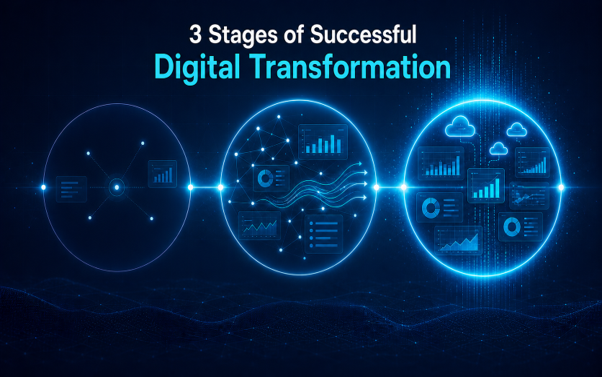
Successful digital transformation is rarely the result of a single big decision. It involves three connected stages: understanding the problem, designing the right approach and delivering the change so it sticks. Each stage has a different focus, but they do not happen in a strict sequence. In practice, all three are revisited continuously as the work progresses.
Delivery regularly produces evidence that changes what came before. User testing may show that part of the design does not fit how people actually work. Architecture work may uncover constraints that were not visible at the outset. Assumptions made early on may turn out to be wrong once real data, real users and real processes are involved. A well-run programme expects this and builds in the space to respond, rather than treating every change as a deviation from the plan.
What matters is keeping a clear line between the problem, the design decisions made to address it and the outcome the organisation is trying to achieve. When that connection holds, new evidence sharpens the approach. When it breaks, changes pile up without anyone being able to say whether they still serve the original purpose. Governance is what maintains that connection, which is why it has to run throughout rather than sit at the end of each stage.
Here, we look at what each stage involves, the warning signs that it is being rushed and how to keep all three connected.
Stage One: Understand The Problem
Successful digital transformation starts with clarity. Before anyone talks about platforms, AI or migration, you need to understand the business challenge, the people affected, how the current process really works and which outcome matters most. If the problem is unclear, the solution usually is too, however well it is built.
That means involving the people who do the work, not just those who manage it. Watching a team walk through a process step by step, and asking why each step exists, often reveals workarounds that no requirements document would capture. We have seen a system go live and be abandoned by its users within days, because the requirements had come from IT rather than the business. Nothing was wrong with the build. The problem had simply never been understood.
This stage must also establish a baseline and the measures that will show whether the change has worked. That means recording where performance stands today, agreeing what success will look like in practical terms and deciding how it will be measured. If success cannot be described and measured before delivery begins, it becomes much harder to prove value afterwards, and much easier for a programme to be judged on whether it went live rather than whether it made a difference.
Warning sign: everyone agrees the project is needed, but each person describes a slightly different problem.
Question to ask: Can we state the problem, who it affects and what success looks like in a few sentences that everyone signs up to?
Stage Two: Design The Right Approach
Design starts with an honest question: does this need technology at all? Some processes should be simplified, standardised or removed before anyone considers automating them.
Where technology is the answer, good design joins up business goals, user needs, architecture, engineering, security and governance so the solution is practical and built for the environment it has to work in. It considers integration with existing systems, who will support it after go-live and whether the organisation can realistically adopt and sustain it. It also avoids unnecessary complexity and unmanaged dependency on particular technologies or suppliers. Relying on a supplier or platform can be the right business choice, but it should be a deliberate one, with the risks, costs and exit options understood, because both complexity and unmanaged dependency add to the total cost of the change long after the project has closed.
This is also where trade-offs need to be made openly. A design that tries to satisfy every stakeholder equally often ends up satisfying none of them well.
Warning sign: the platform has been chosen before the problem has been agreed.
Question to ask: Which trade-offs have we made, who made them and do the people affected understand why?
Stage Three: Deliver And Embed The Change
Transformation only counts when it works in practice. This stage covers implementation, adoption and realising the outcome: making sure the new way of working is used, supported and improved over time.
A slide deck is not transformation; measurable impact is. That impact only becomes visible once the change has been embedded long enough to become normal. This is usually the longest stage, yet it often gets the least attention in project plans, which favour milestones that are easy to schedule, such as build complete and go-live, rather than the ones that take time to settle in.
Embedding the change means measuring adoption rather than assuming it, giving users a clear way to raise problems and tracking benefits against the baseline set in stage one. It also needs a named owner in the business who remains accountable for the outcome once the delivery team has moved on.
But embedding one change is only part of the goal. Done well, this stage leaves the organisation with a lasting capability to keep managing, measuring and improving what has been delivered: the governance, ownership, skills, data and decision-making needed to respond as needs change, whether held in-house or supported by a partner. Without that capability, even a successful change gradually deteriorates, workarounds return and the organisation finds itself facing another large programme a few years later. With it, each change becomes the starting point for the next, and successful digital transformation becomes a continuous discipline rather than a series of one-off projects.
Warning sign: the project is reported as finished at go-live, with no plan to measure adoption or benefits afterwards, and no one equipped to keep improving what was delivered.
Question to ask: Six months after go-live, how will we know whether the outcome has been realised, and who will be responsible for improving it from there?
Recognising Which Stage You Are Really In
One of the most common mistakes is assuming you are further along than you are. A team can be deep into conversations about architecture and platforms while still disagreeing about what problem it is solving. In practice, that team is still in stage one, and any design work is being built on ground that has not been properly cleared.
Being honest about which stage a programme is really in is usually the first step towards getting it back on track. It is uncomfortable in the moment, but far less costly than discovering the gap once build is underway and decisions have to be unpicked and retaken.
Moving back a stage is not failure. If delivery reveals that the problem was misunderstood, the right response is to revisit it, not to push on and hope adoption follows. That holds even late in a programme.
Keeping The Thread Between Stages
The transitions between stages are where programmes often lose pace, particularly the move from design into delivery. When the people who did the thinking are not the people doing the building, the reasoning behind key decisions can be lost in the handover.
The answer is continuity: a clear line from business need to design decision to delivered outcome, and people who understand both the architecture and the realities of delivery. Recording key decisions alongside the reasoning behind them, and keeping some of the same people involved from design through to delivery, means the intent survives the handover. That keeps the three stages working as one coherent programme rather than three separate pieces of work stitched together.
Bring Structure To Your Transformation
Wherever your programme is today, it is rarely too late to bring more structure to the stages ahead. At Emphasys IT, we help organisations understand the real problem, design an approach that fits their environment and stay involved through delivery until the outcome is realised. If your programme is shaping up, stalling or drifting off track, talk to us about where it stands and what it needs next.